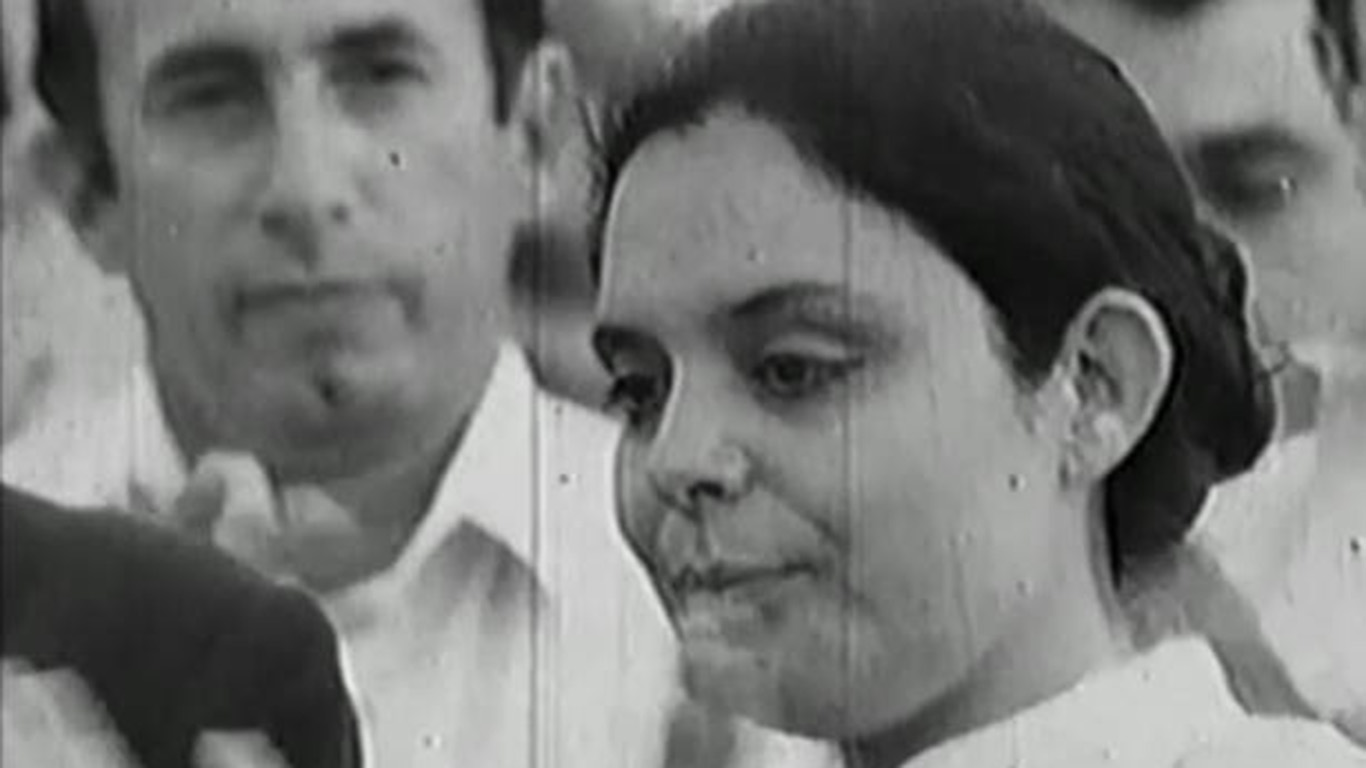
An artist’s voice can break through platforms not originally meant for it. Joseca Yanomami, Brus Rubio Churay, and Aimema Úai make this clear in a photograph circulated on Instagram, each wearing headdresses or face paint associated with their communities. They do not share a passport, nor do they belong to the same generation, but they do share an idea of kinship that transcends national borders. «It was very good to meet other relatives from the Amazon and the Caribbean who live far away,» writes the Yanomami painter in the post. And in another, he adds: «We live far away, but now we are close.» The image encapsulates one of the central themes of the second Bienal das Amazônias (Belém, 2025): bringing together scattered artistic trajectories whose proximity is not obvious and has not been sufficiently studied, but which is activated here through global platforms—international exhibitions, social media—that artists mobilize as spaces to assert their own voices.

The Bienal das Amazônias is symptomatic of a broader change. In just a few years, three exhibitions on the region have taken place in Barcelona, New York, and Paris, and there has been an unprecedented presence of Amazonian artists at the Venice Biennale 2024, Montevideo Biennale 2025, and ARCO Madrid 2025 fair.1 In contrast to this accelerated export, the Bienal das Amazônias is based in Belém: neither a capital city (no Amazonian country or territory, except Suriname, has one in the region) nor a hub of the global art system, but a port in the Brazilian state of Pará. Here, the basin is not exported; the format of the global biennial is imported. Unlike its first edition, this second one articulates the Amazon with the Andes, the Caribbean, and their diasporas in the United States and Europe, from a curatorship led by Manuela Moscoso and Sara Garzón, who are not from the region nor do they live there. The event takes place at a time of intensified circulation (artists such as Joseca Yanomami and River Claure are in Venice as well as here) and discursive homogenization, in which the same lexicon («opacity,» «ancestrality,» «refusal») is replicated, via ChatGPT, in curatorial texts around the world. In this context, what does it mean for the Amazon, as the event promises, to «speak for itself»?
More generally, what does it mean for a region to speak for itself today? The question and the anxiety that accompanies it are not new. In 1989, while Gayatri Spivak questioned whether subaltern subjects could speak beyond dominant ideologies, the third Havana Biennial attempted to articulate a «new international order,» outside of neoliberal capitalism and Soviet communism, with artists from Latin America, Asia, Africa, and the Middle East.2 That horizon today echoes another geopolitical moment. The current presence of artists from regions previously excluded from biennials and art fairs does not herald a «new order,» but rather the consolidation of the existing one: a neoliberal system that does not need to silence differences in order to manage them, privileging the persistent ideal of the singular masterpiece and the individual signature.3 The Bienal das Amazônias does not disrupt this logic; it is part of it.

Unlike the Havana Biennial—which, since its second edition, has included practices classified as folk art—here most of the artists are already established in the contemporary gallery circuit or are entering it. This choice leaves out central fields of Amazonian activity: productions that circulate in craft and tourist markets, or ephemeral practices of grassroots cultural activism. Added to this is a structural contradiction: the infrastructure of the event (a cultural center, the production of the biennial and its partial itinerancy, an ambitious public program that extends beyond the duration of the event) depends on transnational companies such as Shell, whose impact on Amazonian ecosystems contributes to the regional precariousness that the biennial aspires to counteract on a symbolic level.4
However, it would be a mistake to understand these contradictions as a limitation on the region’s ability to «speak for itself.» In reality, Amazonian art has never operated within rigid boundaries between the local and the global, and its entry into the contemporary art system is just one more chapter in a broader history. For decades, producers in the region have circulated through craft and tourist markets, as well as through internationally-oriented activist networks. Since 2004, the International Folk Art Market in Santa Fe, New Mexico, has provided a global platform for Andean and, over time, Amazonian artists, facilitating not only the circulation of works but also the formation of networks of «relatives who live far away.» In Latin America, fairs such as Ruraq maki: hecho a mano (Handmade) in Lima have served a similar function since 2007, connecting artists from different regions of the country with international audiences. These are fully globalized routes that art histories anchored in ideals of fine arts or the avant-garde tend to overlook. Visual languages were forged in these circuits that are now reappearing, scattered, in contemporary fairs and biennials: like a diffuse déjà vu, difficult to pinpoint, whose genealogy still calls for a systematic reading.
Thus, the second Bienal das Amazônias is both a novelty (a contemporary art biennial focused on the region) and a representation inscribed in a much longer history: that of the insertion of Amazonian art into global circuits. What, then, does an event of this kind contribute to the Amazon, if anything? Not a break with the past (the neoliberal model of the biennial remains intact); nor an inaugural character (tourism and craft fairs have already functioned for decades as platforms for international circulation). Its value lies elsewhere. Thanks to the machinery of the biennial, as well as the sensitive curatorship of Moscoso and Garzón—heterogeneous in their selection and interested in providing space for the works to breathe—the event makes déjà vu legible. Trajectories that seemed isolated begin to align. Long-existing but difficult-to-grasp constellations finally shine in relation to each other.
Few events have brought together, for example, enough works to trace a regional history of self-taught Indigenous painting. The small watercolors by the Desano-Tukano artist Sibé (Feliciano Lana, 1937–2020), with their schematic lines and primary colors, represent origin stories in a visual language developed since the 1960s in dialogue with researchers interested in recording Indigenous worldviews. His restrained palette contrasts with the intense red panel that frames them, the same support that, on another floor, holds the works of Joseca Yanomami (b. 1971). Also schematic, his drawings take on a more graphic character through the use of pen and marker, an aesthetic he refined in the 2000s based on his previous work in bilingual education programs. Although painting has always been present in Indigenous cultures—in clothing, objects, and architecture—both artists were pioneers in appropriating the Western genre of figurative painting in Brazil. Working outside the field of fine arts, they shared the same impulse: to translate oral knowledge into images. Their works, however, are not limited to the didactic. Sibé exploits watercolor to produce vaporous atmospheres; Yanomami intensifies the green of the forest through acrylic.

The translation of the local into images intended for foreign audiences crosses national borders, just like the basin itself. In the Peruvian Amazon, the Bora artist Víctor Churay has been selling paintings on vegetable fiber to anthropologists and tourists since the 1990s, paving the way for Indigenous art to enter galleries in Lima.5 Three large canvases by his cousin, Brus Rubio Churay (b. 1983, of Bora and Murui descent), greet visitors near the beginning of the first floor. The paintings revisit motifs explored by Víctor Churay—such as the Chicha de Pijuayo Festival—but reformulate them in a baroque style of their own, saturated with masks, contorted bodies, and dense fur that the acrylic makes tactile. In a productive crossover with the Andes, the biennial also presents works by the Kichwa artist Gustavo Toaquiza Ugsha (b. 1971), heir to the Tigua school of painting—which emerged in Ecuador in the 1970s, in the context of tourist collecting of painted drums—who today reorients that legacy toward an explicit critique of the ecological damage caused by external agents in the Ecuadorian Amazon.

A younger generation is no longer shaped solely by local traditions, but by mobility—both physical and digital—that connects Indigenous territories with global capitals and discourses. The Murui-Muina painter Aimema Úai (b. 1996) works between Bogotá and his native La Chorrera, the epicenter of the rubber genocide and the starting point for multiple Indigenous diasporas, including that of the Churay family. Unlike the pictorial traditions forged in dialogue with tourism and anthropology, his work avoids direct narration: here a maloca is reduced to essential lines, a reminder that not all the knowledge shared within it is available to the foreign gaze. Kuenan Mayu (b. 2003), of Tikuna and Tariana descent, was born in Feijoal and trained in Brasilia. She works with natural pigments on plant bark fabrics, reviving techniques linked to the production of clothing in villages such as those of the Tikuna, Huitoto, and Bora peoples. Although other painters in the region also use these supports, she directs them toward the figuration of bodies that transcend gender binaries, activating the geometric lines and reduced palettes characteristic of Tikuna clothing to affirm her subjectivity as a trans woman.

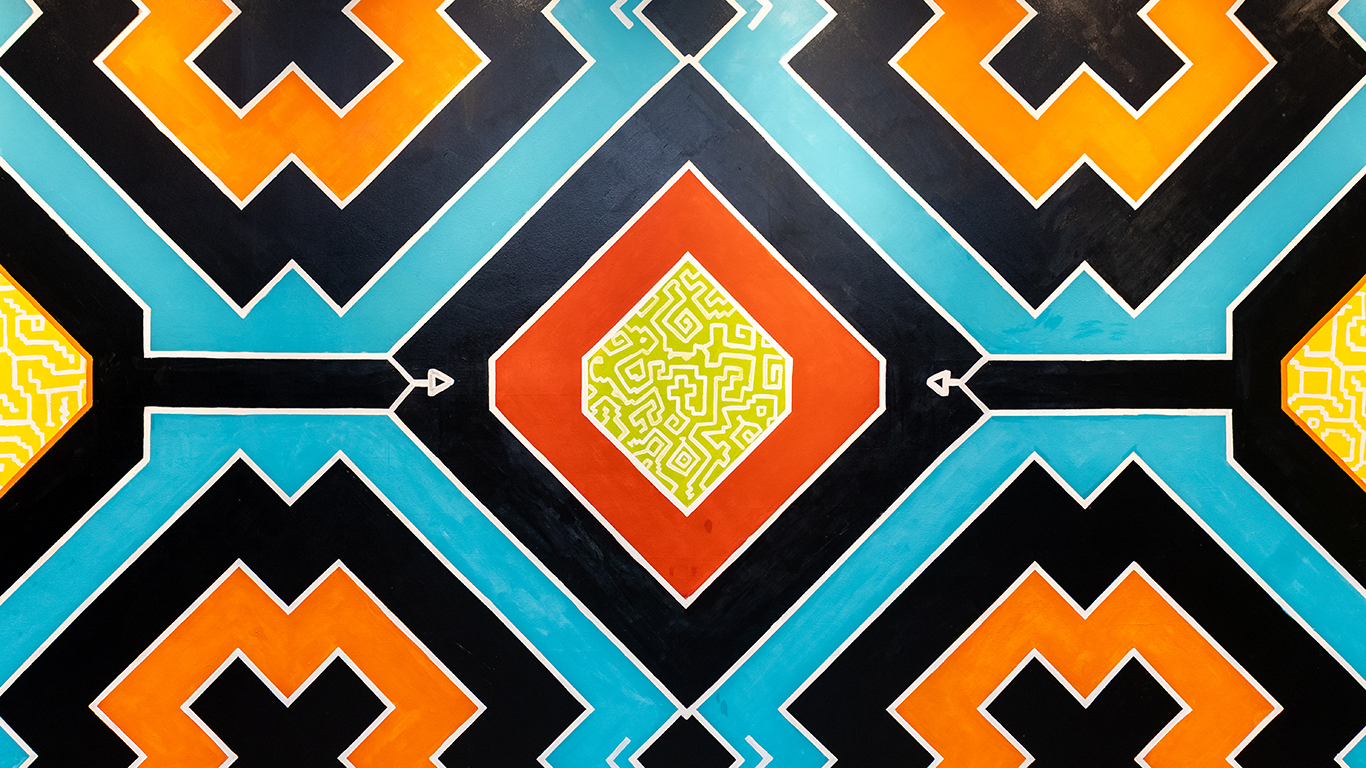
The machismo that for decades regulated who could study, travel, and access intercultural circles helps explain why painting on canvas remained largely in the hands of men. Indigenous women who devoted themselves to weaving and ceramics began to gain visibility in the twenty-first century, thanks to their sustained work and the interest of a new generation of anthropologists and curators operating in the wake of multiculturalism and, later, decolonial theory. Soi Biri (Sara Flores, b. 1950) began her career by selling ceramics decorated with kené—abstract geometric designs central to Shipibo-Konibo spiritual life—in craft markets. In recent decades, this vocabulary has entered the contemporary art system in the form of sculptural-scale ceramic works and canvases, some of which are featured in the biennial. Reshinjabe (Olinda Silvano, b. 1969) also began by selling textiles and beaded jewelry decorated with kené in tourist markets, but has expanded her practice to include collective muralism and the redistribution of authorship and economic agency. Her mural with Jaminthon Martínez Ricopa occupies much of the ground floor: seven meters where the distinction between geometric background and kené lines dissolves. The fact that kené shines here on walls and canvases makes an absence more visible by contrast. Excluded are the media that historically gave it a home: textiles, bracelets, and ceramics for everyday use, of high technical quality but without the pretension—or the need—to be read as unique masterpieces.
Something similar occurs with Andean textiles. Fundamental to rural cultural and economic life, they appear in the biennial mediated by formats—installation, sculpture, canvas—more familiar to the contemporary art circuit. On the ground floor, a joint project brings together ceramics by Aileen Gavonel (b. 1989), a Lima-based artist trained in fine arts, with textiles bearing feminist slogans («We women are alive and together») made by Gavonel herself together with Máxima Acuña (b. 1970), an activist and producer of ponchos and blankets for local markets in Cajamarca. The ensemble reflects Gavonel’s interest in highlighting the aesthetics of one of the most recognized voices in Andean environmental struggles, although this visibility is articulated within the logic of the installation, capable of bringing together disparate objects and styles under the same exhibition framework.

Julieth Morales (b. 1993), for her part, presents long warps of unfinished weaving, suspended vertically like sculptures. The pieces evoke both Postminimalist sculpture and the skirts woven by her grandmother—a Musik tradition that she, having grown up in mestizo contexts, never learned. Their unfinished appearance suggests a fragmented subjectivity that finds a way to recompose itself in manual labor. Kenia Almaraz (b. 1994), born in Santa Cruz de la Sierra and based in Paris, weaves rectangular surfaces with appliqués from Bolivian carnival costumes, which she displays as flat canvases on the wall. Taken together, these works reveal a generational desire to think of Andean textiles as a medium capable of activating non-Eurocentric legacies. At the same time, they make visible a persistent exclusion: the almost total absence (except for Acuña) of the weavers who sustain Andean craft markets, idealized since the early 20th century by governments and anthropologists as guardians of heritage but, precisely for this reason, excluded from the idea of the contemporary.
The journey outlined here traces only some of the constellations that the biennial makes visible. My attention—reflecting my personal interests—has focused on self-taught painting, ceramics, and textiles: the first widely represented; the others deserving of a more heterogeneous presence in future editions. As a Peruvian, I could not help but notice the proximity on the ground floor between the fabrics of Brus Rubio, the kené of Reshinjabe, and the installation by the duo Gavonel–Acuña: three formally and conceptually distinct proposals that reveal the aesthetic heterogeneity of the region. Other possible routes run through the exhibition: painting from the riverine territory (Carla Duncan, Mauricio Igor, Wira Tini), documentary and experimental cinema (Gianfranco Annichini, Simón Uribe, Estado Fósil), and performance art that challenges Eurocentrism (Gwladys Gambie, Rubén Barrios-Rodríguez, the Tawna collective).

The possibility of establishing connections is already announced in the title of the event itself. Verde-distância, taken from a novel by Benedicto Monteiro, is read by the curators less as a division than as a space for «feeling and relating» between geographies and times. However, these relationships are not always clearly articulated in the exhibition. Much of the information developed above does not appear in the exhibition’s explanatory apparatus, making a full understanding of the contexts of production largely dependent on each viewer’s prior knowledge. The poetic texts in the exhibition rooms frequently resort to vague notions such as «affect» or «ancestral knowledge,» without sufficiently anchoring them in the political frameworks and specific visual traditions that would give them specificity. This rhetorical device is common—and equally problematic—in larger-scale biennials such as those in São Paulo or Venice, but it feels like a missed opportunity in a more limited exhibition focused on a specific region. The lack of context, however, is compensated for by the experience in the gallery. Thanks to its contained scale—seventy-four artists and collectives, four levels, three thematic axes—and a museography of luminous walls and panels (bright pink, green, blue, and red) that privilege visual continuity over compartmentalization, the biennial creates conditions for connections to emerge without being dictated. A well-installed exhibition, the curators remind us, makes visual connections more legible than many art history books.
In short, the Bienal das Amazônias does not destabilize the global biennial model; in many ways, it reaffirms it. But it also knows how to take advantage of what an art biennial does best. Unlike fairs such as the International Folk Art Market or Art Basel, the biennial provides space and a pause in the circulation of goods—it allows specific objects to be viewed alongside each other and attended to calmly. That this takes place in Belém, a city more accessible to Amazonian artists than New York or Venice, is no minor detail. Here, visual traditions and their producers can speak in the first person and to each other; and, if they so choose, they can continue those conversations on their own narratives, inside and outside the exhibition hall, and also on social media. By bringing together «relatives who live far away,» whose dispersion has made systematic readings difficult, the exhibition reveals how Amazonian arts have negotiated for decades with external mediations: first anthropology and tourism, and now also contemporary art fairs and biennials. It is a moment framed within a broader and still ongoing history: the history of a region that was never outside the global system, but learned early on to operate from within its gears.
The contribution of the biennial, then, is not to «make the Amazon speak» in a language supposedly never heard before, but to make clear how many of its artists have been speaking for decades through globalized neoliberal channels. These platforms may be foreign, but they are appropriate, tense, and strategically used. By bringing together previously scattered trajectories under a single platform, the event operates as a stratigraphic cut: an entry not into a regional or racial essence, but into prolonged processes of injustice, friction, and agency. A history that has unfolded—and will continue to unfold—with or without the permission of the contemporary art system.

Imagen central: Olinda Silvano (Paoyhan, Perú, 1969), en colaboración con Jaminthon Martínez Ricopa, Sin título, acrílico sobre muro, 11 x 3.5 m (detalle). Fotografía: Ana Dias, cortesía Bienal da Amazonías, Bélem
Notas
- The sixth Montevideo Biennial (2025) was entitled Amazonas ancestral, and the ARCO Madrid 2025 fair included the Wametisé section, focused on the region. Recent exhibitions outside Latin America include Amazònies: el futur ancestral (Centre de Cultura Contemporània de Barcelona, 2024), Amazonia açu (Americas Society, New York, 2025), and Amazônia: créations et futurs autochtones (Musée du quai Branly, Paris, 2025). A precursor to this international visibility was the exhibition Amazonías, presented at Matadero Madrid in the context of ARCO 2019.
- Rachel Weiss, “A Certain Place and a Certain Time: The Third Bienal de La Habana and the Origins of the Global Exhibition,” Afterall, April 20, 2011, accessed December 9, 2025.
- Recent interventions proposing this critical perspective include those by Gerardo Mosquera, «Cambios en el mundo, cambios en el arte,» YouTube video, November 20, 2025, Centro Atlántico de Arte Moderno de Gran Canaria; Alfredo Villar, “Civilizing Cannibals: Decolonization and Neocolonization in Amazonian Art,” lecture, Sorbonne Nouvelle, Paris, November 12, 2025; Oliver Basciano, “2nd Biennial of the Amazon: To Live Is to Persevere,” Art Review, November 7, 2025.
- Coordinator of Indigenous Organizations of the Amazon Basin. “Greenwashing the Amazon” COICA, June 11, 2024, accessed January 15, 2026.
- For a pioneering study from the perspective of art history, see María Eugenia Yllia, “Transformación e identidad en la estética amazónica, la pintura sobre Llanchama del artista bora Víctor Churay Roque,” bachelor’s thesis (National University of San Marcos, 2011).
01.02.2026